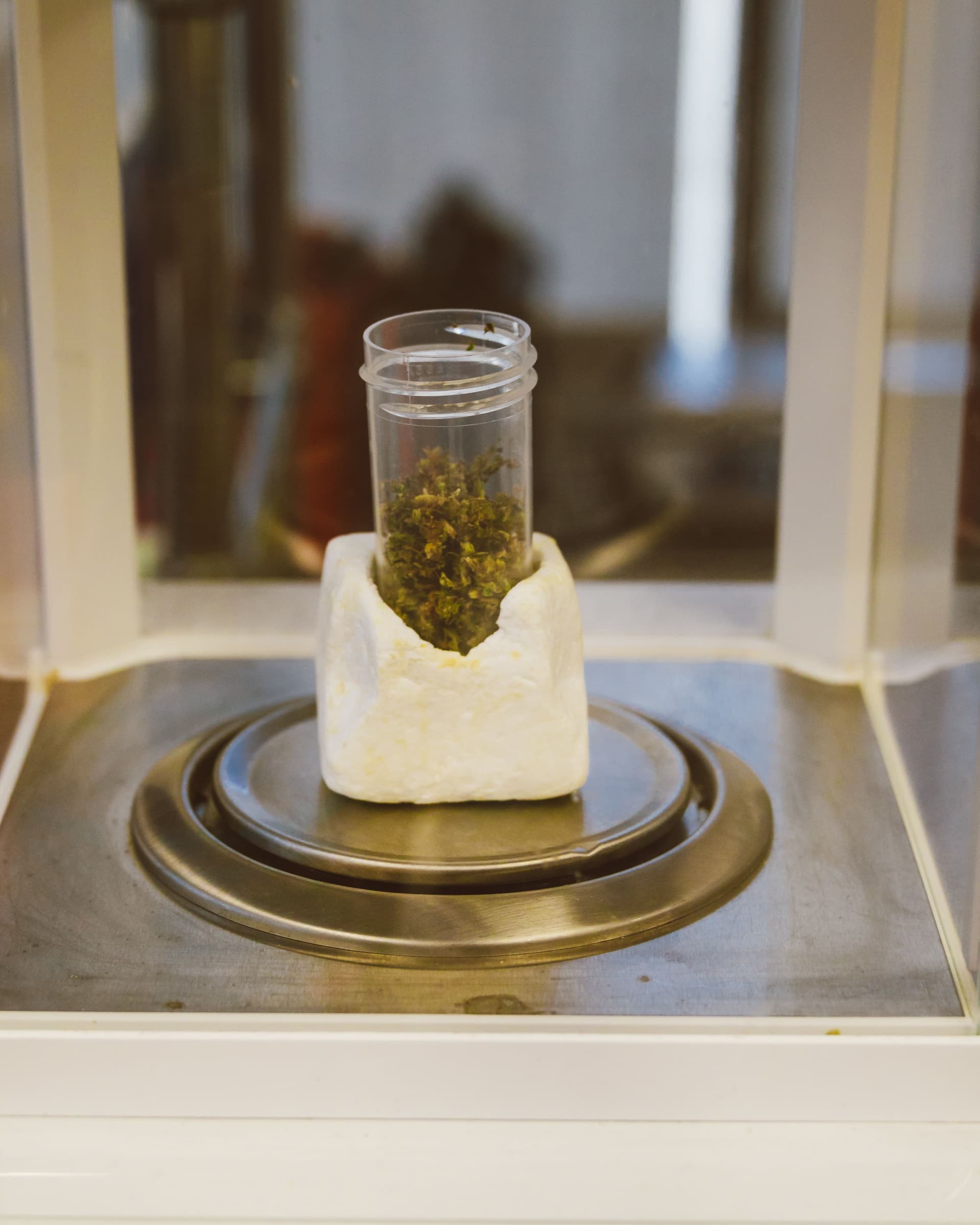
Testing rules were written for uniform products. Moon rocks are three materials assembled by hand.
Cannabis testing regulation is built around homogeneous products. A harvest lot of flower is close enough to uniform that a sample drawn from it stands in for the rest. A batch of distillate is uniform by definition, because it was mixed. Sampling rules, batch size limits and homogeneity requirements all rest on that assumption, and for most of the market the assumption holds.
A moon rock breaks it. Three materials are assembled by hand into individual pieces, in a ratio that varies from piece to piece. There is no mixing step that makes the batch uniform, because the batch is not a volume of anything. It is a count of separately built objects.
That leaves producers and laboratories with two workable approaches, and they produce different numbers.
The first is composite sampling. Several pieces are taken from the batch, homogenised together, and tested as one sample. The figure that comes back is a true measurement, and it is a true measurement of the average. It says nothing about how far any individual piece sits from that average.
The second is calculation. Each component is tested on its own, the ratio used in assembly is recorded, and the finished figure is computed from the two. This is faster and cheaper, and it is only as accurate as the ratio. If the assembly ratio drifts, the calculated figure drifts with it while the arithmetic stays perfectly consistent.
Both approaches are used, and a label rarely says which one produced the number on it.
None of this indicates that anyone is misreporting. Composite sampling and calculated figures are both legitimate and both are provided for in state testing frameworks. The point is narrower: a single number describing a hand-assembled composite carries less information than the same number describing a jar of flower, and the difference is structural rather than a matter of anyone's diligence.
The practical consequence for a buyer is that comparing two composite products on their headline figures alone compares two averages that may have been derived by different methods from batches with different internal spread. The more useful comparison is between producers, because the thing that actually varies is the consistency of assembly, and no potency figure reports it.
For a current producer example of the three-layer format, see the Presidential moon rock product range.